
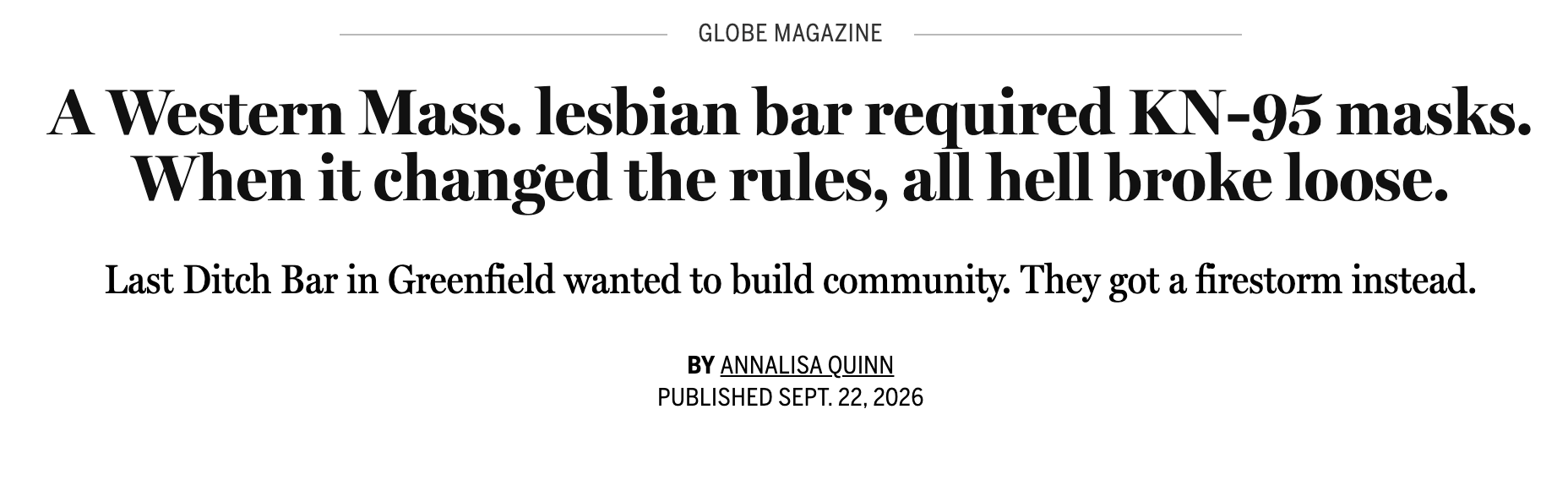
Everyone sent me the story. It was built for me in a lab. It broke in the Boston Globe:
Reporter Max Tani tweeted that “per a note to the Boston Globe staff today, the lesbian bar story generated 1,000 subscriptions to the paper yesterday. The Globe’s managing editor said it was ‘by far our best performing story of the year,’ and appears to be ‘on pace to shatter all sorts of Globe records.” Sounds fine. Nothing to worry about, it’s not like there is anything else in the world going on.
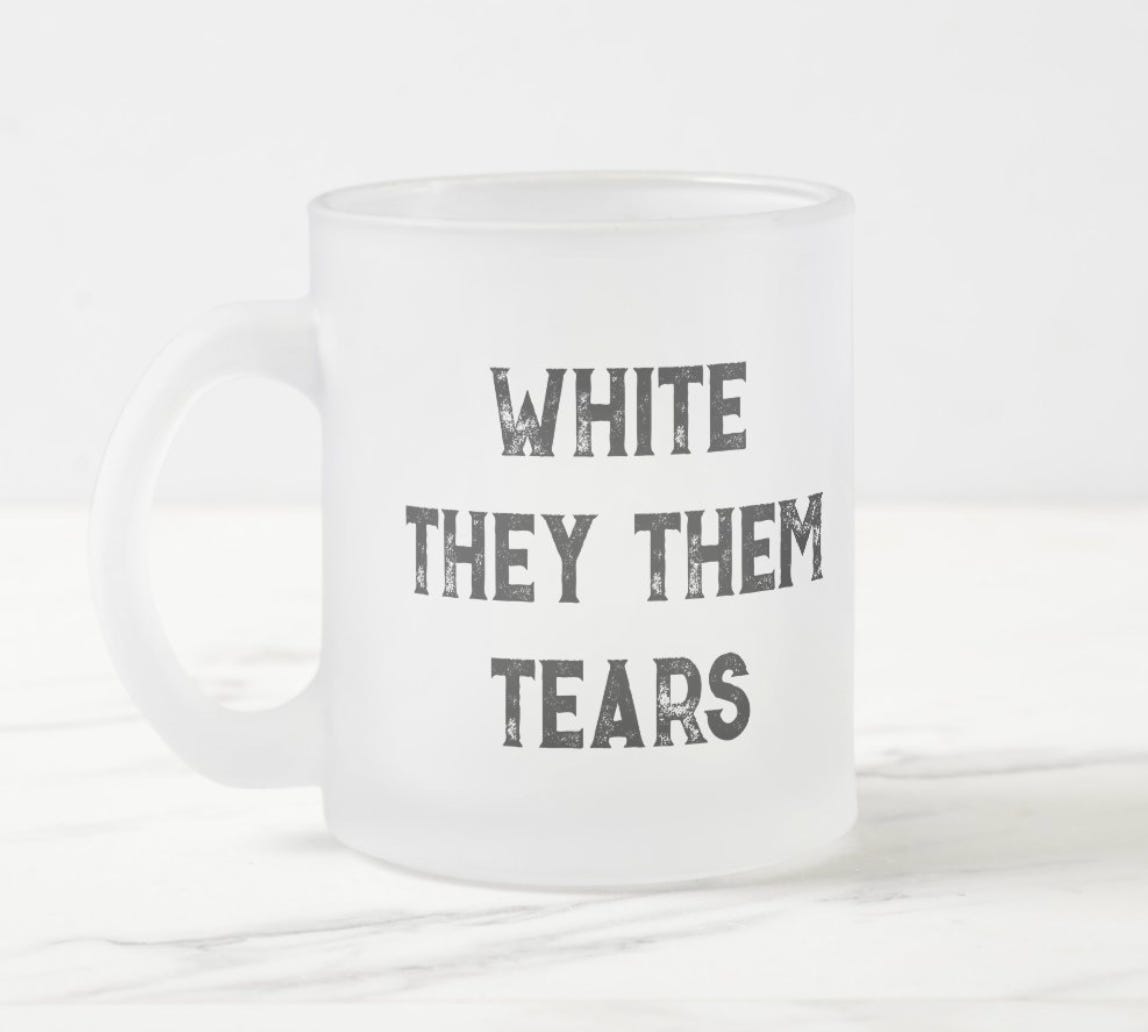
Here is the gist, if you’ve missed it: a lesbian bar in Western Mass had a mandatory KN-95 mask policy, which was changed when the bar, Last Ditch, wrote on Instagram “it is with love we inform our immunocompromised disabled divas we will be opening Saturday nights as mask optional.” The decision came from financial pressure to keep the bar afloat: the owner was behind on bills and couldn’t pay staff. The one owner left with the bills (another owner had left to enroll in clown school) had lived in her truck and was working four jobs. When she mentioned this to the hybrid in-person/online Zoom meeting about the future of the bar and masking, she is told she’s centering her feelings and SHEDDING “WHITE THEY THEM TEARS,” according to the bar’s most vocal online critic. A mediator present at the meeting was accused of being an agent of the state and made someone named Moss feel unsafe. The bar’s apology post for being ableist was called out for being inaccessible and thus, still ableist.
Unfortunately the article does read like:
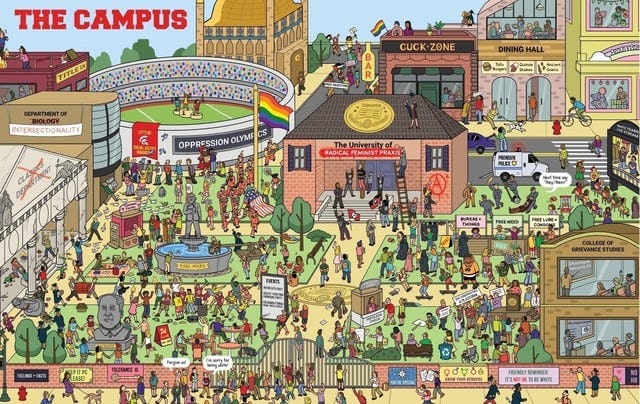
It is conservative jerk-off material. It reads like a parody of the left, because in very actual ways, it is. Even with a generosity of spirit about what was trying to happen here, it’s okay to think what is being described is funny, because it is objectively funny. (My “This bar is not a safe space for revolutionary praxis” t-shirt is garnering more questions than answers). The mannerisms described in the article should be distinguished as being profoundly unproductive behaviors, even if the goals are good ones, because this sort of rigidity is myopic, ineffective, and deeply selfish, ironically, even as it aims to improve the lives of everyone. What often is taken for “activism” especially in internet spaces is often a few loud bullies on a moral high-horse, who will sacrifice general progress that requires compromise over feeling unassailable and personally Correct.
If you are stuck in a knee-jerk, 2019-era way of talking to potential collaborators, where you demand compensation for the labor of educating them and redirect from substantive issues you should indeed be lovingly pulled towards the light, handed a copy of The Politics of Everybody and kindly instructed to refrain from tweeting until we figure out what the hell is going on here. The response to this article should be a damning indictment and a particular wake-up call for the covid conscious about the unfortunate necessity of adopting better “branding” so as to appeal to the uninitiated. This does not mean giving up, it does not mean that they are wrong, it means accepting an unfortunate reality: strategy matters. When you behave in a way that is unappealing and only understood (linguistically or otherwise) by people very in your niche group, you will not be taken seriously by your potential comrades, and you will be giving plentiful ammo to your enemies. Many people “on the left” laughing at this article are not, I suspect, laughing at the desire to have spaces that serve more people, or at disability, or queerness, but at the very relatable experience of bringing a lot of people who care about things together and watching them absolutely annihilate each other in the process, all while gaslighting the fuck out of you by insisting their behavior is not alienating, actually, it’s activism, it’s moral, it’s correct. But if you don’t agree and don’t use the same words to express that, you can fuck off and die!
It also bums me the fuck out, both because 1) we shouldn’t know about this situation and 2) it only remains funny if it is discussed in an in-group that you can be assured finds the right parts funny, like how therapy speak makes us evil, not larger themes such as, say, being Covid conscious or being queer or wanting to work together to make community spaces that serve as many people as possible. It’s like in Mean Girls when the Burn Book comes out and Damian is described as being “too gay to function,” to which Janis responds: “that’s only funny when I say it!”
Why is this story a Lightning Rod (Helen Dewitt style) to the extent we have people living in the community talking about it, people living abroad, so-called “leftists,” disability activists, anti-cancel culture pundits, anti-masking grifters, Ted Cruz and the Free Press? If the Free Press is reporting on “what happened at the Long Covid Lesbian Bar” right along with “the left” something is rotten, and no mask will dispel that stench. It has been thrust into the national spotlight and picked up by the worst people, making it now feel socially irresponsible to say that I think it’s funny, which to be clear I still do. The colorful cast of characters described soon became “lol cows” for both sides of the aisle. Is this progress? No <3. It is making me, as my partner put it, want to tap the Brandy Jensen sign:
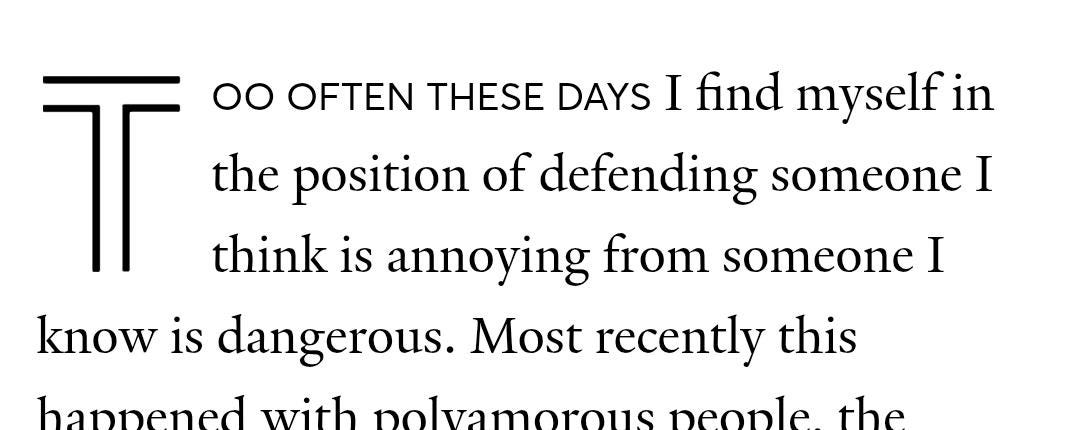
And so here we find ourselves, in the position of defending people we find annoying from people we know are dangerous.
Though it may seem the story broke containment when it was covered in the Globe, it seems it was the Instagram post that did it, with more niche outlets (podcasts) covering the “drama” at the time it happened. This is unsurprising to me: every time I use Instagram, I am served a call-out post, hyperlocal drama, community discussion, or otherwise completely un-applicable to me happening that is wedged in between people I actually know. Why this is so dominant in the algorithm is clear: these posts generate discourse and disagreement and thus revenue by keeping you on the app, so they float to the top of the feed, even if you’ve never met a single person involved. It was how I had seen and saved the initial post about the mask mandate change in a town I did not live in and have never been to, before the story broke, with snippets of the ensuing hubbub going from viral posts, to national news, to international laughing stock.
The Instagram post had comments like this, which were featured in the article without context, and still present on the initial post until comments were removed, with the bar posting a story saying they were being inundated by hate messages and that the reporting failed to accurately convey what was happening.
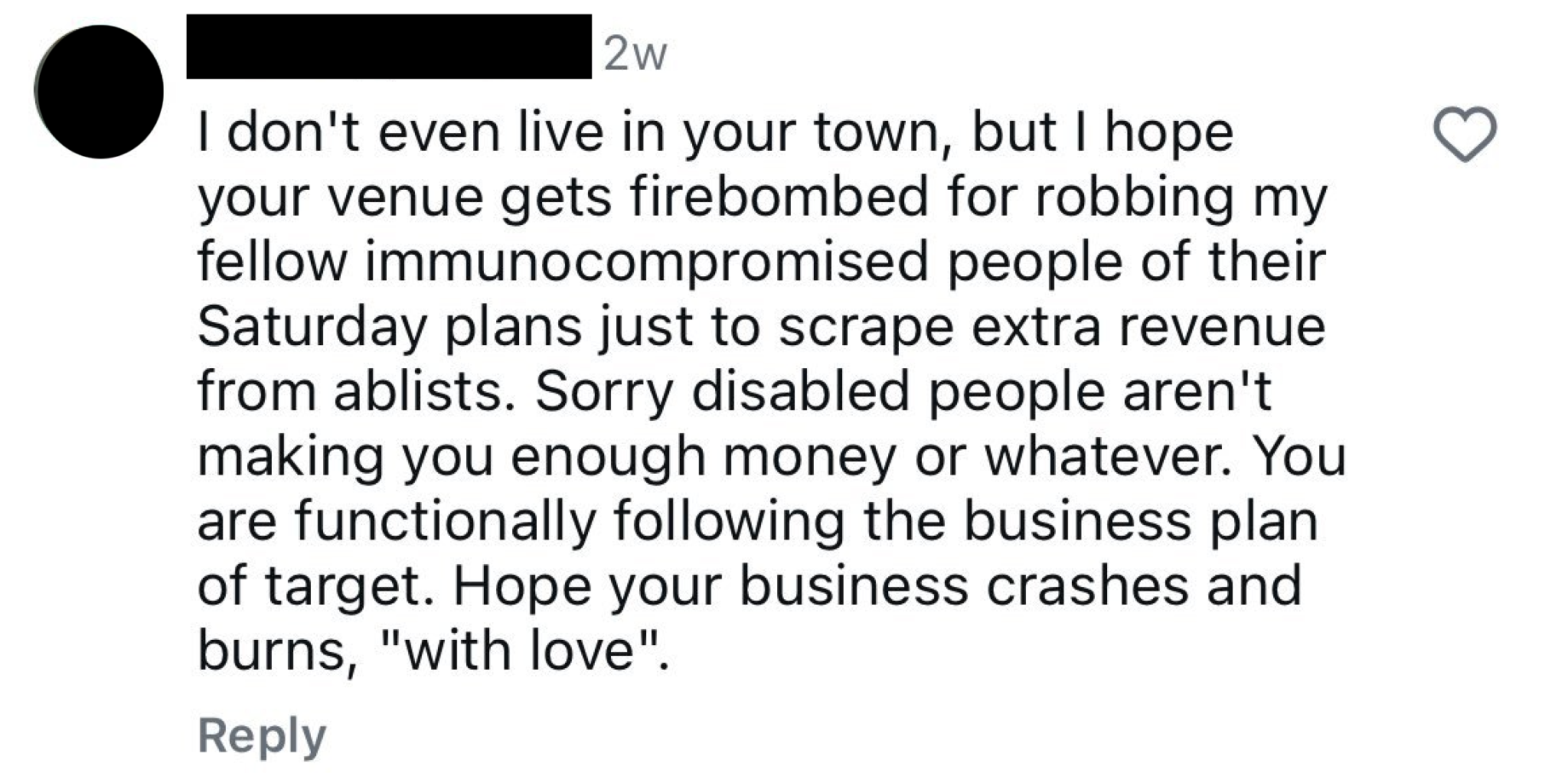
In the article, this comment was quoted with the first part left off, which feels important.
I don’t even live in your town. Is that not enough context to say, actually then, this discussion may not be for you? Or is the “I hope you get firebombed” enough to discredit this person as being a serious thinker with actionable critique? Other comments quoted in the article include “Just say you’re being complicit in a mass disabling event and get it over with,” and “people like you kill disabled people in the name of your own leisure and convenience.”
The article presents this type of commenter as being emblematic of a widely held viewpoint when what this shows is a very specific type of person primarily online who has, in many ways, lost the plot of how to communicate effectively due to being in a very, very intense bubble. This kind of person is most often regurgitating what have now become copy-pasta like phrases about Covid and disability that are unapproachable and absurd, that condemn everyone who disagrees with them as not only being wrong but genuinely evil. This behavior is (but should not be) used as evidence against masking, or evidence that those who still mask are somehow disconnected from reality, or that Covid is over. It conflates the behavior of a trenchant, very small, but extremely vocal subset of primarily digital morality policing weirdos with anyone who cares, with anyone queer, with anyone who doesn’t want their comrades to get sick. This is a loss for everyone involved, including those who likely fervently believe they are waging war in Instagram comments in service of the public good.
See this tweet from @bimbotheory:
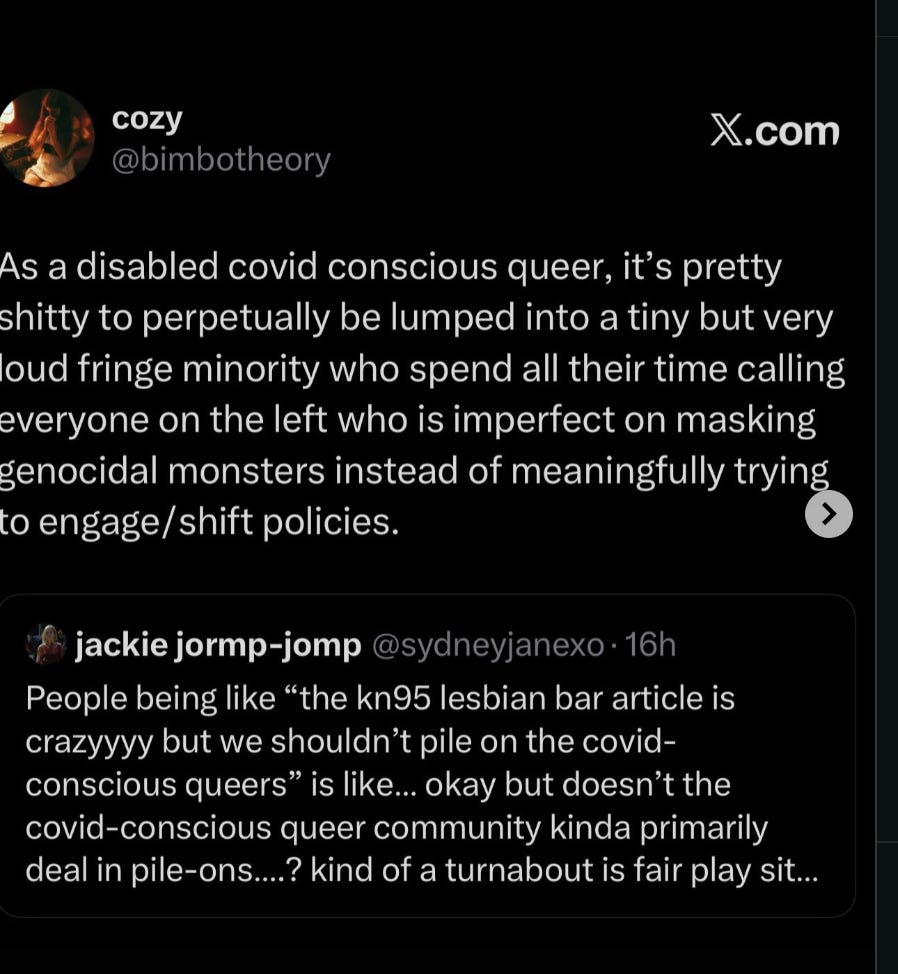
Yes. That’s it exactly, from my conversations with people who feel this way, this seems to be the reasonable take away.
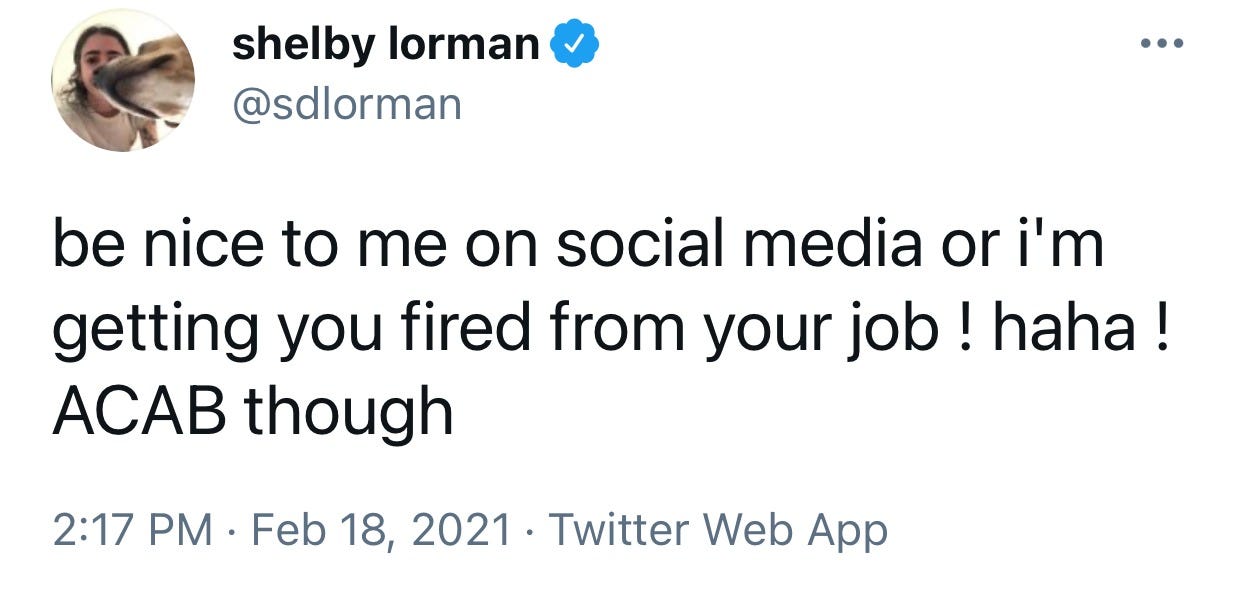
Perhaps part of why the story went viral is because of the very basic tension between people who supposedly want to keep everyone safe, and the alienating language they use – hope you get firebombed, you must want everyone to die – to communicate these goals. This is likely novel to those who have never spent time in specific corners of the internet. This was not, in the slightest, new to me, or many others I know. If you care about things, or are disabled, or spend a lot of time online, or any combination of those things, you will have encountered someone who means well but who has completely lost a sense of scale, who will gleefully and truthfully call for your social annihilation, to be fired from your job, to be ostracized from community, because you didn’t _________ and they saw you and you will be held accountable for this, as if you, alone, are responsible for both the health and sickness of the nation.
About four years ago I wrote an article for The Guardian about how shaming was not an effective means of changing people’s minds about Covid. It was about my initial response to people posting that they were still partying, maskless, during the beginning of the pandemic, and how much this upset me. I took this extremely personally, as a person with chronic illness. It wasn’t just that people I followed didn’t care, it was that they were out to get me. I wrote about how my instinct was to post shameful selfies with captions like I’ll not look at some of you the same way again, etc. Truly ominous stuff, from me, but at the time it felt like praxis to post, it felt radical, it felt like I was really changing people’s minds. I wrote at the time:
This did not fix things, but turned me into a real-life version of Charlie from It’s Always Sunny in Philadelphia, with his wall of suspects and red string, assessing who was trustworthy and who had moved down the rankings. The things people posted, or didn’t post, became a treatise on their own Coronavirus Pandemic Rollout Plan, every acquaintance promoted to the role of public health official. People in my social circle were quickly rendered into a false flatness, one that made me feel in control at a time when we all so desperately sought – and failed to find – any semblance of control. Soon, it became a constant, near obsessive monitoring.
My point, in the broad scheme of things, was that when there are no structural solutions to a crisis, i.e. Covid, the instinct to look laterally and blame each other becomes ever more enticing. It was easier for me to blame people I knew for acting differently than me, to try to tweak individual behaviors, than to cope with the massive failure of the state, to accept they were yet again abandoning us, and that disabled people would be the first to die. I knew this, I knew the direction my rage should be funneled, and yet I struggled to reorient meaningfully. I wrote:
How do we navigate empathy when the structures meant to “care” for us are breaking or nonexistent?” Blame, like grief, feels ambient in these times. There is too much of it. Nowhere to place it squarely, nowhere to lay it to rest. Early in the pandemic I felt myself toggling between the weight of what was happening around us and smaller, more textural sins – the ones I felt I could understand, or at least use as distraction from larger and more unbearable truths. I yearned for the partiers to be publicly shamed. I didn’t want them to be sick, but there was a sort of knowing “figures …” when they would test positive for Covid. I hated myself for thinking this, and I thought it anyway. Me, who has been chronically ill my whole life, who has a body that constantly fails me, a brain that careens often into darker corners I would rather not go – I couldn’t bridge the gap.
After this article, I was called a eugenicist. I was unfollowed by a wide swath of “disability activists” who equated my writing about personal experience with shame, and its ineffectiveness as a strategy, to me “desiring the death of disabled people,” of which I was one. At the time, not many people seemed to disagree with them, or if they did, it was done quietly. I simply stopped posting as much, not wanting to risk being seen as a supporter of eugenics because people had given up on understanding what words meant. For years, a small subset of the loudest, most annoying people online seemed to be hellbent on making my life miserable, on uncharitable interpretations to everything I uttered, and at the time I took this to be something unique to me, some unseeable aspect of my being that was also a lightning rod. But this is simply what it is to exist on the internet. The lack of care from those in charge meant those with a following (or those that slipped from context and went viral) were charged with caring more, as if they alone could make up the deficit. I, like many other public figures, absorbed much of the ambient blame. People couldn’t rage and get a response from the people actually killing us, but they could bully a niche internet figure into responding, into waging a war in the comments section, and maybe that will feel like it’s moving the needle, even though it’s not, we’ll yell about celebrities not being able to save us and then applaud when they do the Good Tweet. We will not be able to get universal healthcare, but we can be an absolute bitch to someone about not having alt-text on their post, in such a way that makes it clear this ask was not actually done for someone who needs alt-text, but to feel superior, to feel morally righteous, to continue down the strange path of using disability as a cudgel in which instead of working for a better world for all, you punish your potential comrades for not knowing all you do. “Perfect is the enemy of the good,” or whatever Voltaire said.
On some level, I believe this is what has happened with masking, too. Masking is made binary by some very online people in such a way that 1) makes it seem impossible, which it is not and 2) allows no wiggle room or adjustment, and assumes that if people don’t mask as they do, they must want to kill all their neighbors. Of course some of these people have driven themselves into further isolation: it is a paranoid delusion that wraps itself in the language of progress, so that continuing to be anti-social can be framed as noble boundary-setting, and not ineffective organizing.
There are, and have been, widespread failures to ensure other public health interventions, such as better air ventilation and testing. It is not that masking doesn’t work, or should be made fun of, especially by people who consider themselves leftists. You should not, in fact, want your comrades to be disabled. But without these larger health interventions, is it fair to charge every person who doesn’t mask the way you do with wanting to kill their neighbors? No, it is not. If you genuinely want more people to mask, perhaps telling them where to get free masks and handing out a pamphlet on why it still matters is a better use of time than telling them they are MURDERING EVERYONE ON PURPOSE. From a PR standpoint, it is incumbent on the Covid cautious to be, unfortunately, extremely savvy about how to advance their OBJECTIVELY CORRECT mission. Is that ableist? Of course it is. “Everything is ableist,” my very good disabled friend told me. And it is. A better world would look different, but we will not build a better world on the firebombed ruins of a mask-mandating lesbian bar.
Why this story? Why now? For the conservative imagination this is everything wrong with “the left” which conveniently allows “the left” to be correlated to a very specific situation and niche group of loud voices – it reminds me of what I wrote about recently in regards to “anti-cancel culture influencers” who often have a simmering why I left the left vibe about them, who conflate annoying people who might share politics with them for the entire political project. Here is what I wrote about “cancel culture,” which feels relevant:
The lack of a shared definition benefits those who use the phrase most cynically: if it ever is referring to a real problem, it is overshadowed by the dominant use of the term, which is used to make fun of earnest efforts to make spaces safer for people, gloss over the actions of an abuser, push everything challenging under the rug, etc. That some “leftists” seem to parrot these same arguments should be cause for pause: do you want abusers and grifters in your organizing efforts? How would you handle this? But then how do we talk about that other thing happening, that is often called cancel culture but perhaps isn’t, that refers to a particular kind of behavior usually found on the internet but which has certainly crept offline, that encourages lashing out and posting manically as a way to seek justice or conflict resolution?
Did this story touch a nerve because it’s six years on from when masking first became part of everyday discourse and people can watch from afar and say, I can’t believe people still care about that, disregarding the fact that everyone, in fact, should still care? Is it because of the language used? Is it because it reveals, so precisely, how even the best-intentioned people can be extremely offputting when they are stuck in a way of communicating that does not align with the IRL world? Does making fun of these people allow distance, to allow people to see when they are too deep in the weeds, or does it make them feel persecuted, and thus double down in their anti-social position, now having confirmation that indeed the whole world is out to get them? Is it because of context collapse? Of the strange and uncomfortable truth that some people may share your vision but not your approach, and you have to learn how to work with these people?
For the uncharitable, it is because it makes a mockery out of everyone involved, which unfortunately then trickles down to making a mockery out of important and needed things: queer spaces, Covid cautious spaces. I do not want to laugh at those things, nor do I want the type of people described in the article to be emblematic of the larger push for inclusivity, because their behavior is, and should be noted as, unproductive. But there is a catharsis, undoubtedly, to seeing the widespread disagreement with the type of behavior modeled in the article, to being at a point where we can acknowledge they are right and that it’s very funny, and a wider acceptance that how you say things matters, actually, and if you want people on your side you might have to make it attractive for them to do so.
On a very basic level, the article is funny. It allows distance from the type of internet activism many engaged in and have since outgrown, and emblematizes the way that anti-social behavior can take many forms: some of it looking like an obsessive commitment to righteousness that, while in earnest may be trying to make things better, results mostly in making everyone around them miserable. (Here is where I remind everyone I wrote a book about the obsession with seeming good .)
A commitment to immiseration is a telltale sign of an internet-addled-good-intentions-haver. These people do not want to advance a political goal, they want everyone to be as miserable and lonely as them. And I say this because I was that. When I was sickest, loneliest, and most isolated, I did not want to calmly explain to someone why they should care about disabled people. I wanted to rage, I wanted to yell, I wanted to scream and embarrass them. That my mean comments racked up hundreds or thousands of likes gave me a dopamine boost that was better than any medicine, any drug. It locked me in a feedback loop, the simmering notifications became the back-beat to my nervous system. Perhaps my already faulty wiring made me more susceptible to such ways of thinking, perhaps my body—which already punishes me for existing—craved the false support, the ego inflation, borne from metrics which meant nothing, but felt like everything. My hostile behavior was celebrated and thus felt vital. There was no impetus for change, staying right where I was got plenty of attention and praise.
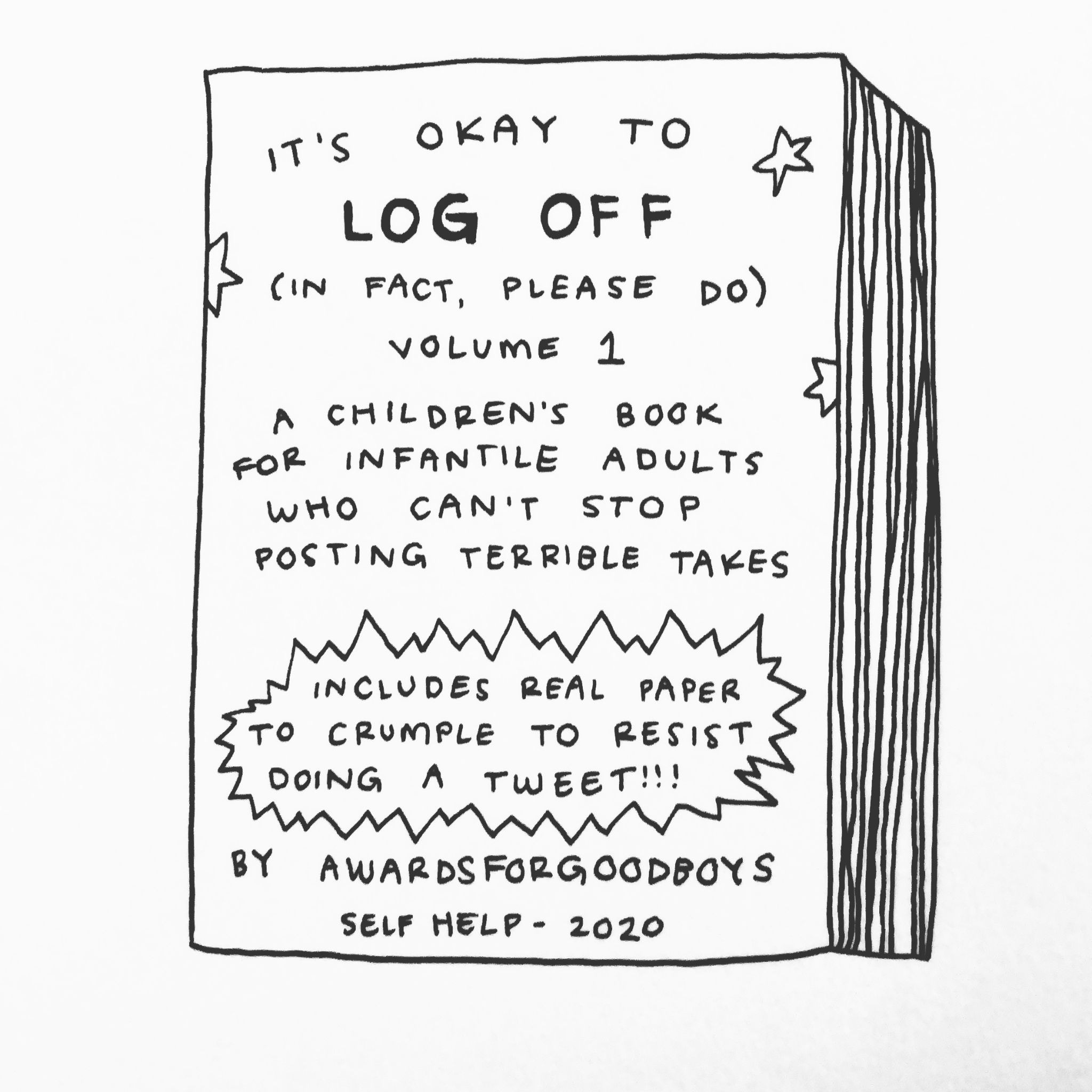
Here, again, from the Guardian article I wrote;
In the absolute despair of isolation, I found myself talking so much about community, but did very little to tap into mine. I would preach to strangers, judge my friends, shout into the void – all while my body hurt more than ever, like a neon exit sign begging me to stop. If only I read a few more posts about this cataclysmic situation we’re all living through, if only I shared a couple more links, then perhaps this would change things. Try caps lock next time. Rinse, repeat.
And perhaps this all comes back, in earnest, to fear. Fear of contamination, fear of sickness, fear of what could happen. Again from that article: “No one deserves to get sick, and more so, sickness doesn’t care. It can’t see what we post, it doesn’t take into account our moral positioning. A hermetic existence may have not been able to prevent you or a loved one from getting sick. Illness is unknowable, uncertain and inevitable. Perhaps that’s why it scares us so much.”
Im clapping