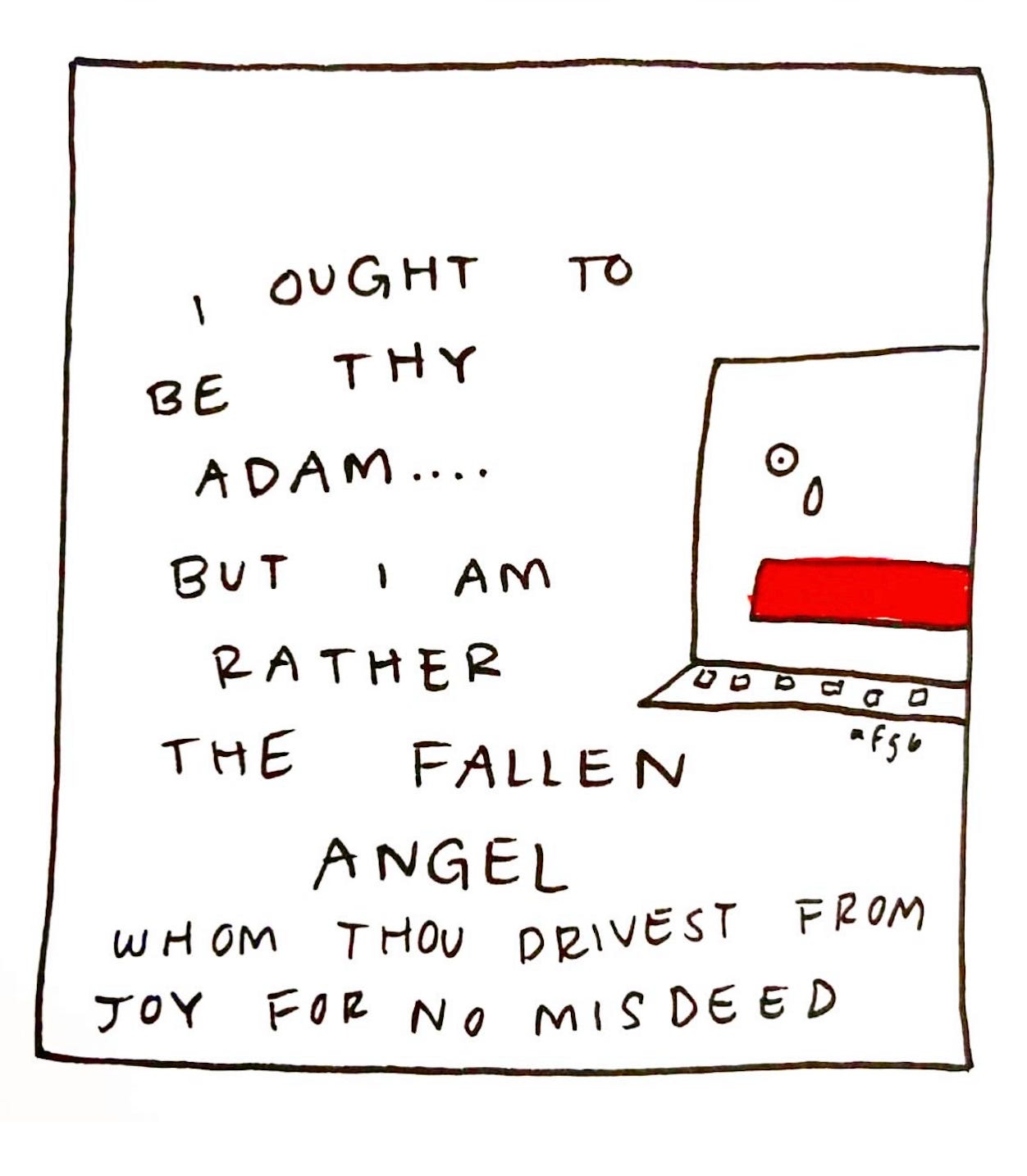
Over the past year, I’ve done a series of interviews with people about their experience of cancel culture. I have talked to people who make content about cancel culture as a way of exploring its impacts, with people who have suffered material and emotional damages as a result of smear campaigns, and with people who were swept up in feeling intensely about someone they did not even know. I have talked to people who had no other option to warn people about someone’s bad behavior but to post on the internet, which often gets lumped in with larger criticisms about call-out culture and cancel culture. (My friend Aiden wrote a great chapter on this in her book, you can read us discussing it here). I have yet to connect with someone who spearheaded a cancellation campaign and how they feel about it now–please get in touch if that’s you and you want to talk, or if any of the previous categories apply, my email is wide open.
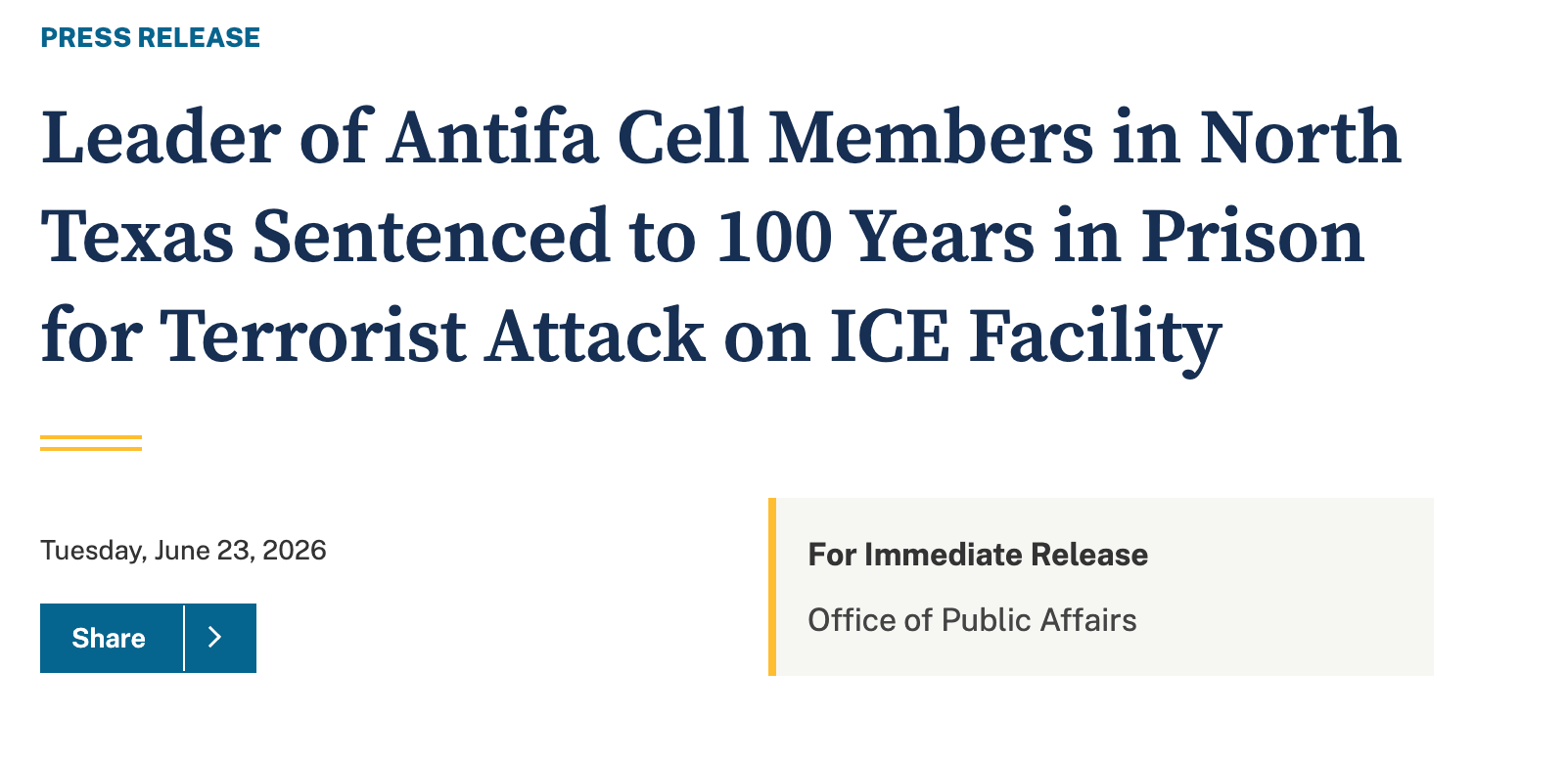
I won’t be publishing those here (yet), but it has been endlessly interesting to discuss these terms and concepts with people who are thinking about and experiencing them in different contexts. It has cemented for me that 1) people use the term cancel culture to mean a variety of things and 2) that while something is certainly happening, the umbrella term does a disservice, particularly as it mimics conservative narratives of the likes of Bari Weiss or Joe Rogan, adding fuel to the fire of “left eating itself alive” at a moment where you may be jailed for being “head of Antifa.” Cancel culture can mean almost anything, depending on who is using it. The right wing version might refer to legal punishment for a rapist. For a “leftist” it might mean a series of snarky tweets that three people see. It might be used in jest, to say it doesn’t exist, look at all the people who should be cancelled and are not, which remains true. It might be used seriously to try to name the strange behavior that seems to breed in certain backwaters of the social justice internet, interchangeably called cancel culture, accountability, public shaming, purity culture, morality policing. It may be used by someone referring to too-stringent behavioral standards that make organizing harder, or by a Manosphere influencer feeling fragile about more-than-justified criticism. The lack of a shared definition benefits those who use the phrase most cynically: if it ever is referring to a real problem, it is overshadowed by the dominant use of the term, which is used to make fun of earnest efforts to make spaces safer for people, gloss over the actions of an abuser, push everything challenging under the rug, etc. That some “leftists” seem to parrot these same arguments should be cause for pause: do you want abusers and grifters in your organizing efforts? How would you handle this? But then how do we talk about that other thing happening, that is often called cancel culture but perhaps isn’t, that refers to a particular kind of behavior usually found on the internet but which has certainly crept offline, that encourages lashing out and posting manically as a way to seek justice or conflict resolution? That too, may very well (and does) hinder organizing efforts. But is calling it cancel culture the way to explore what such behavior does or figure out how to resolve it? Or does it allow people who disagree on the whole with “cancel culture” an easy heuristic of not having to think about complicated problems? (I think, sometimes, about Kim Stanley Robinson’s Red Mars trilogy, and about the shock–for some–of how building a socialist society on a terraformed world did not magically eradicate sexual assault, something they must think deeply about.)
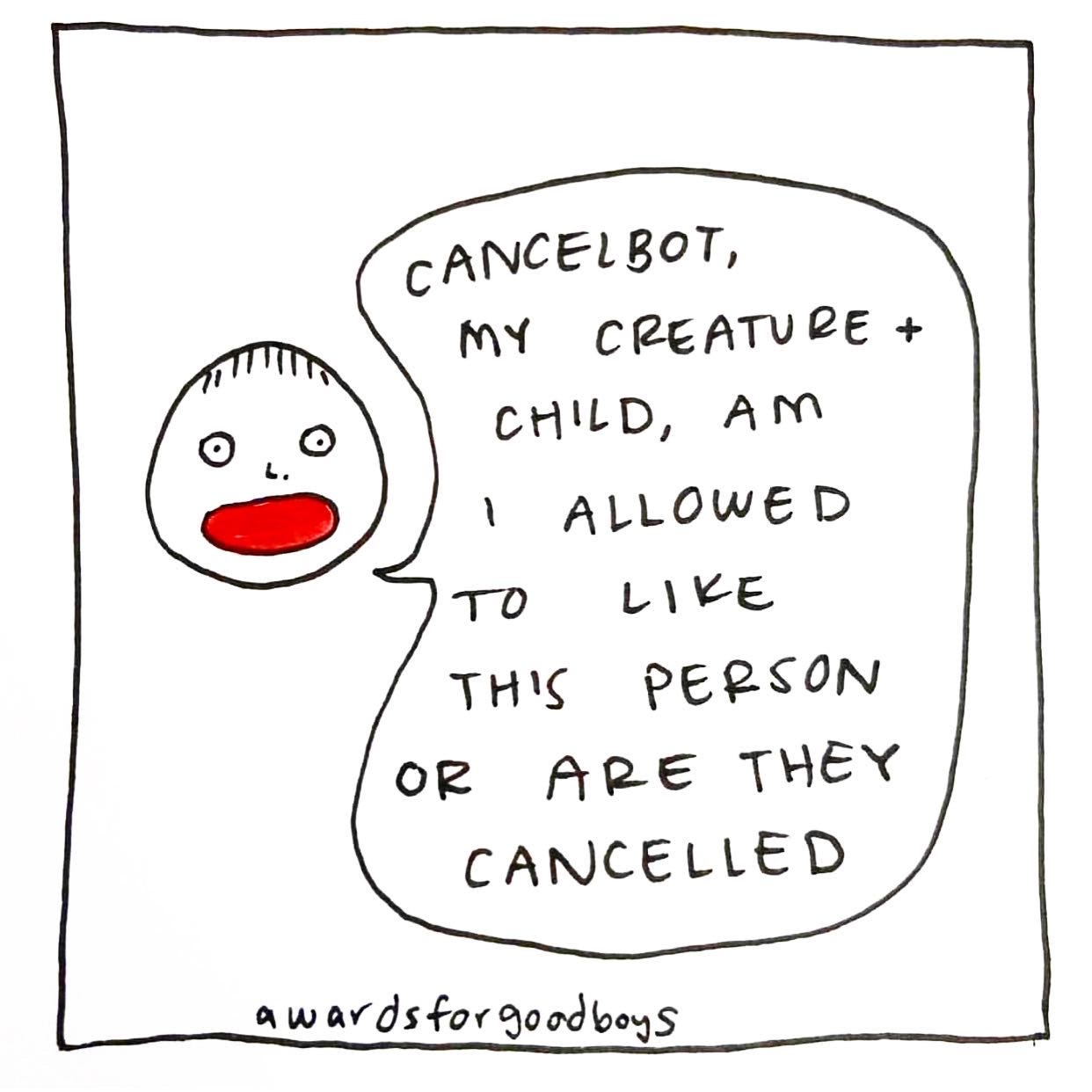
I am thinking about this now because I have started to see a trend: the rise of the anti-cancel culture influencer. I have seen one set of slides in particular shared abundantly, but I will keep this broad in hopes of pointing to a larger pattern rather than individual behavior. This discourse is committed to documenting and understanding cancel culture, usually from the “left.” They do not, as far as I can see, ever define “cancel culture” or “the left,” making it impossible to understand what, exactly, they are talking about, and to whom it applies. I suspect most of my ire with such content comes from just this: it’s a semantics problem, where they are naming something but it is not what they are calling it. Instead the anti-cancel culture influencer makes a series of convincing points encouraging people to think critically about public shaming, which seems a worthwhile endeavor, and also likely speaks to people who have seen the internet grow more and more punitive. But when this is done under the heading of “cancel culture is destroying the left,” who benefits? What does it do to use reactionary language at this moment in history, to blame your supposed comrades for their annoying behavior as the reason people do not want to join the left? While certainly what is being named here might happen somewhere and would be an important discussion where and when it is happening, as it is presented broadly, it is counterproductive. Why is the entirety of the “left” being blamed for what seems, frankly, like a problem predominantly present among white queer women on TikTok?
People don’t want to join the left for a variety of reasons, but it’s not “cancel culture.” It is more likely a rigid commitment to capitalism. The myopic focus on “the left” when it comes from “the left” seems hollow at this moment in time–it is not that such criticisms are without purpose, simply that the repetitive focus is misplaced, and becomes its own sort of delusion, rather like the intensive focus of “cancel campaigns” these people try to criticize. At some point, probably now, it would behoove us all to pick a better enemy, hopefully someone that is not ostensibly on our side. That does not mean, however, that anyone who feasibly shares your politics must be a collaborator, or that genuine discussion between people who are on the same side but disagree is always unproductive. If anything, it means being more open to productive conflict in order to find common goals, and more stringent about who we want to represent us in this pivotal moment–see the Graham Platner nightmare. Some said that criticizing him–a former mercenary with credible sexual assault allegations and a Nazi tattoo–was indicative of cancel culture. Again, the collapse of meaning only serves to uphold people who should not be in power. He was a bad candidate–saying so was not an offshoot of cancel culture but a realistic survey of strategy and a demand for better elected officials.
Let us try to untangle some of these threads. Something is happening, particularly within “left” leaning internet spaces, and that something looks very different from the way right wing media consumers are suffering, and that something is often called “cancel culture.” I think this might be what the aspiring anti-cancel culture influencer is trying to name: a specific sort of behavior that makes solidarity more challenging, and is often an extension of internet culture and the specifically “liberal” demands for “correct” behavior at the expense of working towards shared goals. If right wing internet psychosis looks more like Q-Anon, AI-generated flyers about chemtrails, conspiracy theory, transvestigations, body dysmorphia diluted into workout content, rampant misinformation, a complete fracturing of shared reality, the “left” online is undergoing a different sort of internet induced psychosis, one that looks ever inward, a cursed kaleidoscope.
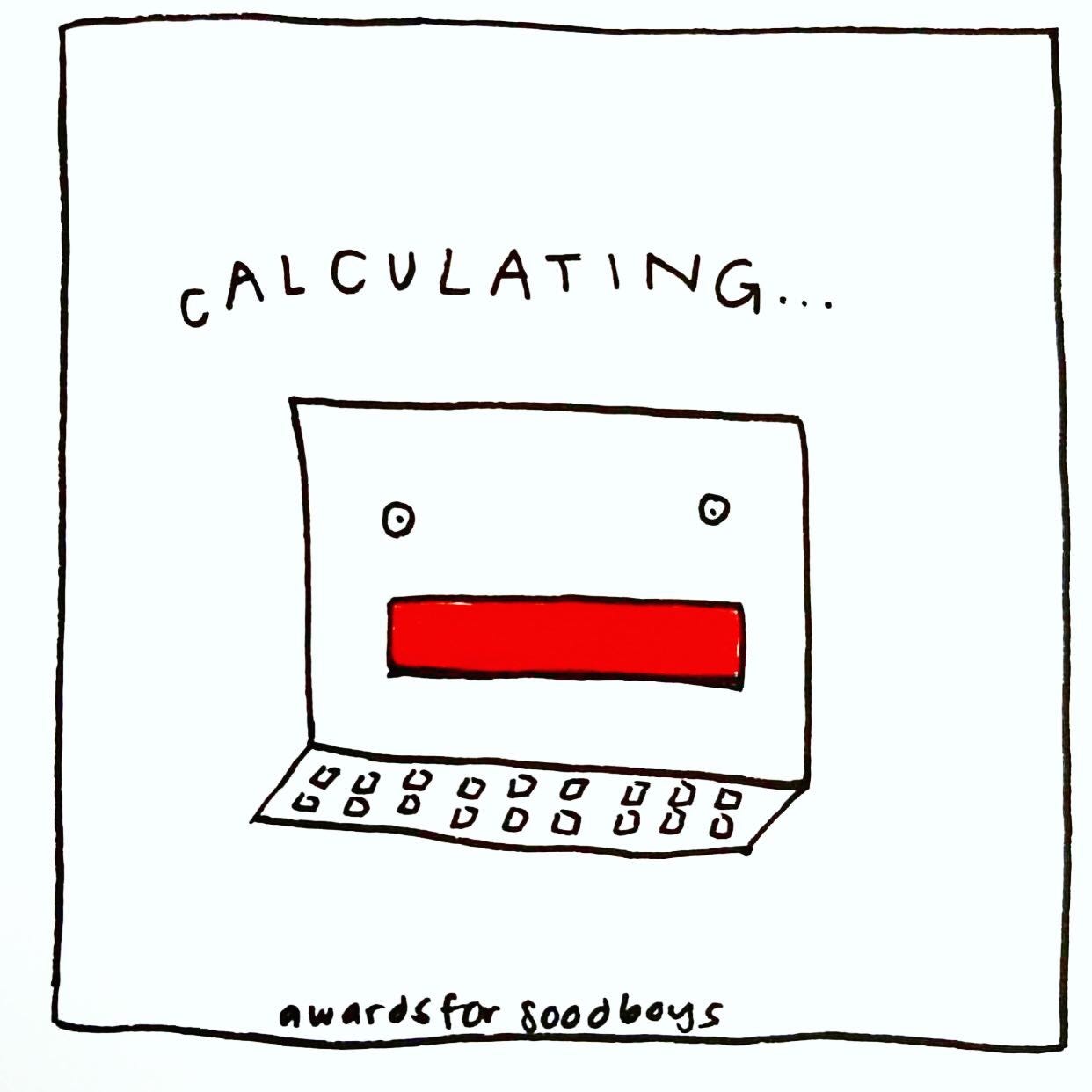
Far below the upper echelons of power, where those who should be held to account remain unaccountable, something is indeed happening. Some sort of soup of vigilante justice is attempting to measure out infractions and keep the peace, which makes sense, and is often justified. Perhaps it is the very last option, the only way to voice something. Or perhaps it is done for personal attention. Is this feminism, the working of a life-saving whisper network, or are such framings applied post-hoc to give credence to bad behavior? I suspect much of the confusion around “cancel culture” comes from the broad context in which it is used, the way it can dually be used to deny the necessity for any personal responsibility, or to overemphasize personality responsibility and blame an individual person for structural problems, meting out a punishment that does not seem warranted or adequately explained. That amidst all this confusion the genuine “call out” often remains the last option for someone desperately trying to seek remediation, failed by “formal” infrastructure, for harm they suffered is a distressing reality, and one that makes the wholesale writing off of “cancel culture” immediately suspect. Who is getting cancelled, for what, by whom? Such questions matter, as does inquiry into what “cancel” actually means. Are they being subject to a public shaming campaign with no actionable steps? Are they being asked to show up in a community space and try to amend harm, and the internet was the only remaining outlet? Speaking about “cancelling” as a broad umbrella term does little to address whatever is happening, instead feeding into panics using verbatim conservative talking points.
I was never really a Canceller but I was most definitely a tried and true public shamer, which I have written about before. At the time (2019/2020, mostly) I took this to be some sort of important activism, the best use of my platform, which people constantly told me (during their own “cancellation” or “call in” attempts) that I could and should be using “to save lives.” I inadvertently started a cancellation campaign against the singer Father John Misty after I trolled a bit too hard. I would dunk people in comments sections and relish the thousands of likes on my “snappy” responses (I made one, “it’s called branding, Alan!” into a sticker that I sold). (I wrote about this in 2019 in an article aptly titled “are they the trolls or am I?”). I intentionally started a hate train against what was then my very recent ex-boyfriend after he broke our “don’t talk about the breakup in public” agreement by going on a podcast and announcing it, to which I responded by going scorched earth and rallying my thousands of mostly women followers to unfollow him en masse. Normal, well adjusted behavior, is what I’m saying, that was algorithmically reinforced to confirm I was doing something right. Yes queen! Icon! Ok, guess it’s fine then! Actually, it’s better than fine, I’m saving women! By being a cunt with no boundaries! By dealing with real interpersonal conflict that actually does not impact other people in PUBLIC! For attention that I could call activism! Now like and subscribe!
Even when I was not naming a specific target to contain my ire, other people were: my cartoons all looked the same, deliberately, every single one is the same circle. And yet people were hellbent on solving what seemed to them like a delicious riddle, trying to puzzle out who the cartoons referred to. That I insisted my work was almost entirely about patterns and not people was scoffed at; that was less fun than naming people, either celebrities or my exes, and tagging them in the comments to be sure I saw their clue-solving. The people, the platform, capitalism—all of it encourages individuation, and if it’s not offered, everything can be gamified. It’s really:
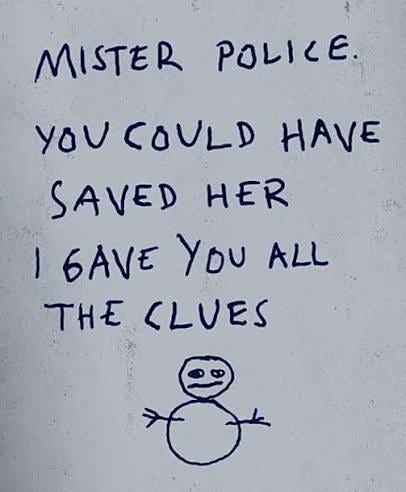
Nuance is not shareable, but naming is. The internet demands singularity (not in the Hyperion way, yet), and if one isn’t getting it on their own the next best bet is to hitch your star to someone else, to talk about how they are failing, to do this in a way that gets you attention. You could make it politically relevant, i.e. about someone with material capacity to change things in the world, but you won’t get as many views as if you pick a niche person that you have taken to be more important than they are because of their following count. (See: every single “snark” thread that tells themselves they are doing important unpacking of modern femininity and actually just function as agents of the surveillance state.) You may truly, deeply, feel that the “work” you are doing as an internet vigilante holding strangers to Account is important. It may be near impossible to get you to peel back a layer, to wonder where this rage comes from, to question whether it can be redirected in more productive ways. It may, too, make you incapable of distinguishing what sort of “cancel” or “call-out” is legitimate. You may eventually become so disgusted with such collapsing of urgent interventions and attention-grabbing-stunts that you disavow any and all behavior that looks like this as a response, swinging from one pendulum to another.
I think most of it at the core comes down to a feeling of powerlessness: inability to influence what really matters. (Father John Misty I will never forgive you!). It recalls Holly Lewis writing in The Politics of Everybody, “because capitalism is a system of social relations, not a person, static group, or moral agreement, it does not respond to moral arguments or moral outrage.” So where, then, to put moral outrage? On a random person, certainly. If you’re feeling overwhelmed by the lack of accountability in the world, you can take personal responsibility, Young Shopper, you can simply follow or unfollow the latest Problematic person and wipe your hands of them, voila, life is so easy. Lewis also writes, “Personal awareness campaigns - the solution to all liberal pluralism’s problems - displace calls for system change. Ethics is the final frontier of social change within the liberal pluralist world because the market, is by nature, blameless. The market is imagined to operate principally at the microeconomic level. It is a manifestation of and a servant to our desires. Thus, the desiring consumer subject is the root of the world’s problems.” (It makes me think of a topic I almost wrote about today, the overemphasis on “influencers” being the bane of society, when ultimately they are simply a symptom of late capitalism, not its cause. To complicate this conversation some influencers make it about “hating women,” as Kate Lindsay wrote about in this post, but that too feels like a semantics problem, trying to address the unease of influencers existing by slotting it into pseudo-feminist discourse.)
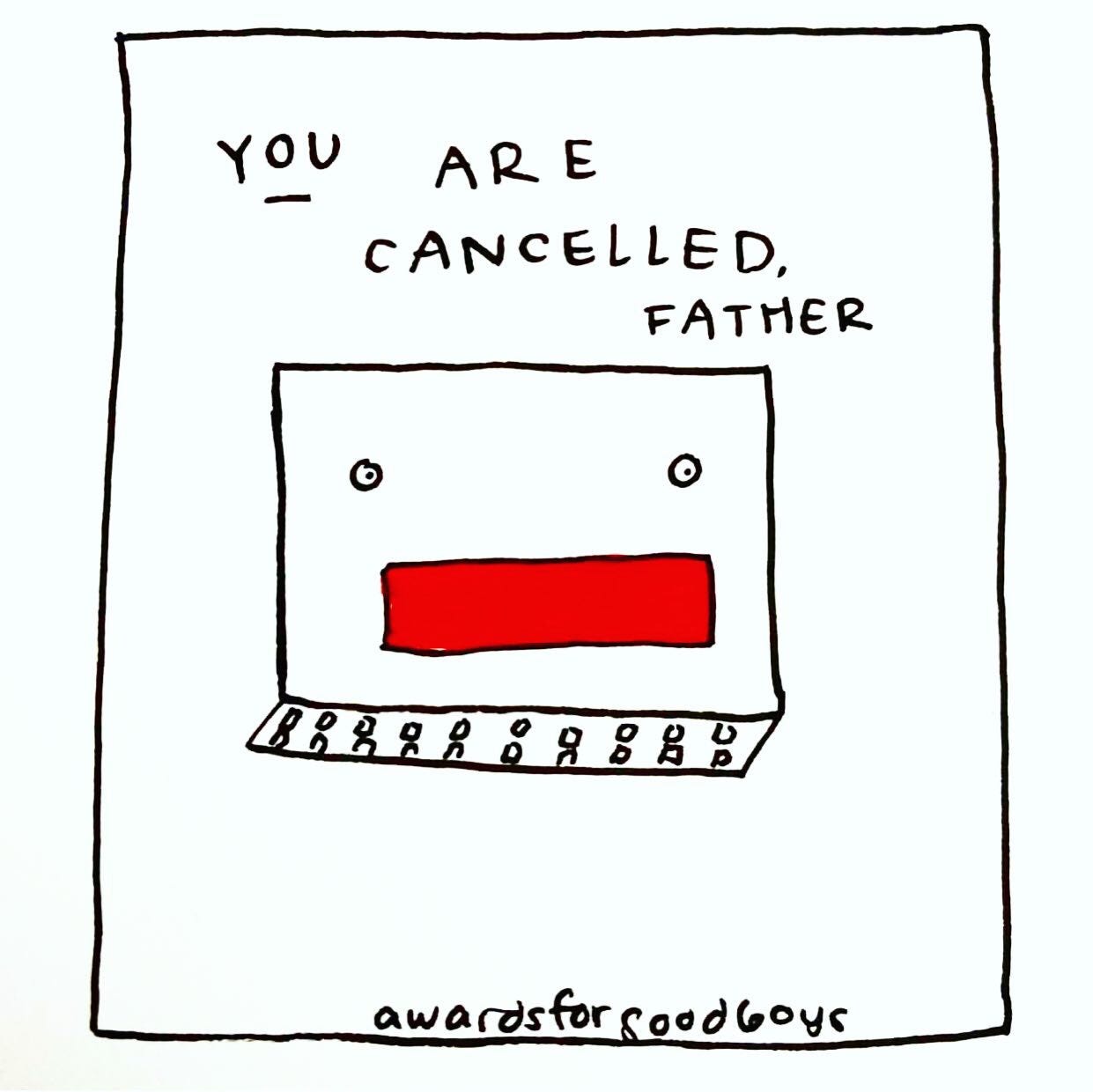
I do not think any of the above are examples of cancel culture, which I’m starting to feel doesn’t really exist, but rather instances of the unique sort of insanity that ferments when one has looked into the distorted mirror of the internet for too long and can no longer see clearly, a circumstance of which I was deeply and thoroughly entrenched. And this situation does seem to be specific to what can broadly be called “leftists” but is actually politically more complicated, stemming from a mix of beliefs that are unclear (because who can tell with online discourse where it is very easy to be dogmatic). The intense attention to detail of lefty netizens does seem specific to people who otherwise consider themselves to be Good, to be on the right side of history. These are ideologies cobbled together from an assemblage of How To Be, formed by mainlining slideshows into their already internet-lobomotized noggin. Maybe what some people mean when they talk about cancel culture is this behavior, a specific way of being that exists mostly online, and how this bifurcates people who are ostensibly on “the same side.” It is often called infighting, but anyone who has seen a “cancel campaign” knows such efforts are not always connected to true criticism but often a personal vendetta cloaked in the language of internet activism. Often the end-goal is self-flaggelation in the form of an apology post that will never be good enough. Are incels doing this? I doubt it. How, then, do we separate ego-driven impulses from what are potentially true criticisms and necessary interventions? Is it still cancel culture? Can we really use a term that has such broad and interchangeable meanings? Does this only exist on the internet? Perhaps the sheer number of necessary follow-up questions is why seeing anti-cancellation content has struck me strangely as of late.
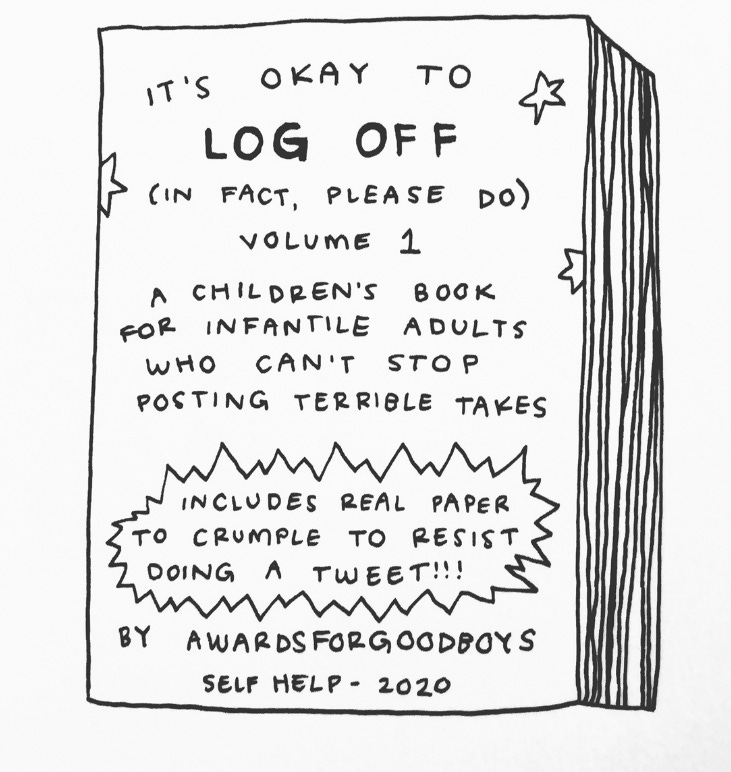
On the surface I am perhaps the ideal candidate for this sort of discussion: I have been interviewing people about this, I’ve been “cancelled” a dozen times, and have written about the impetus of such behavior for years. In my Awards for Good Boys book I wrote:
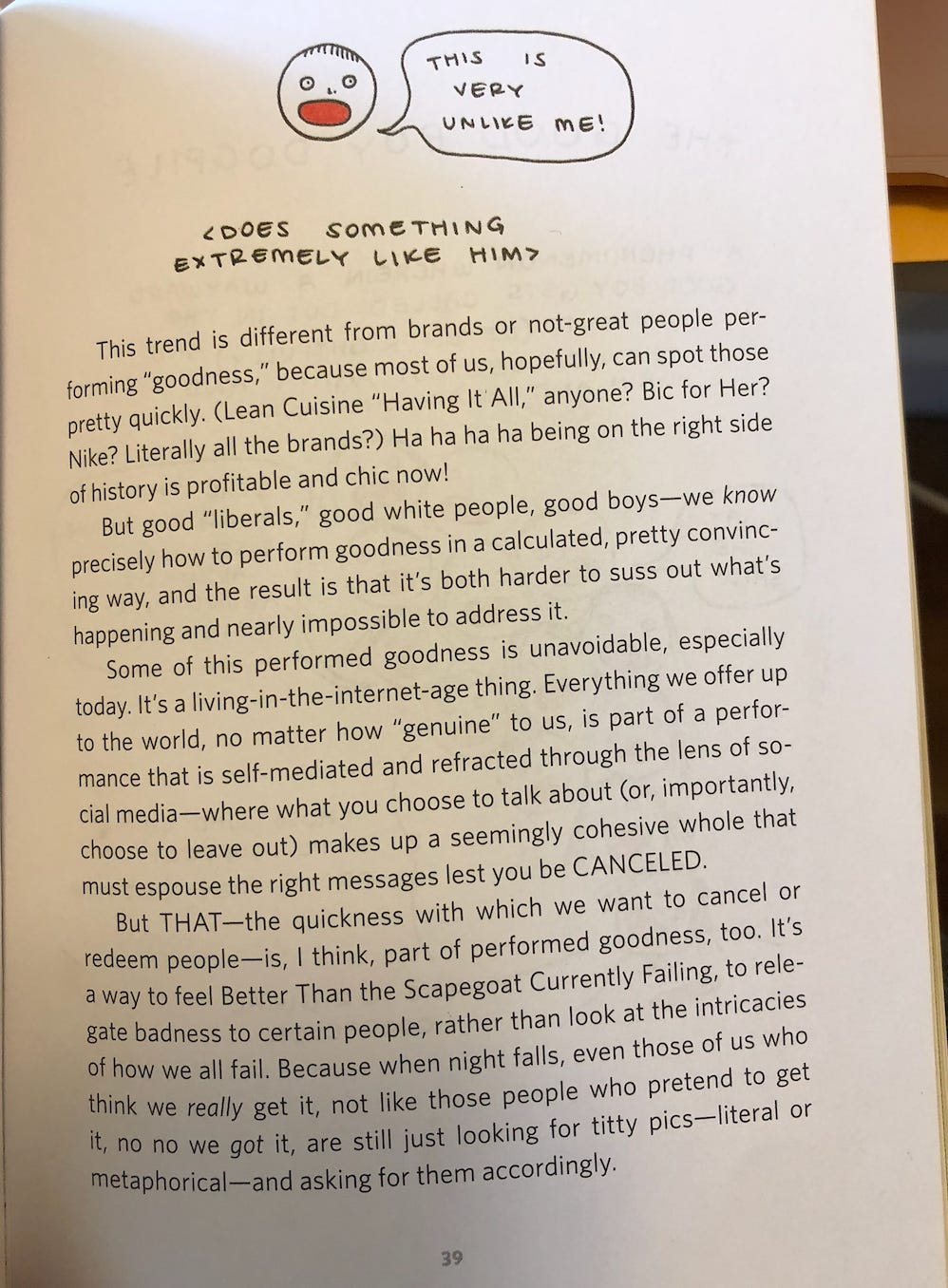
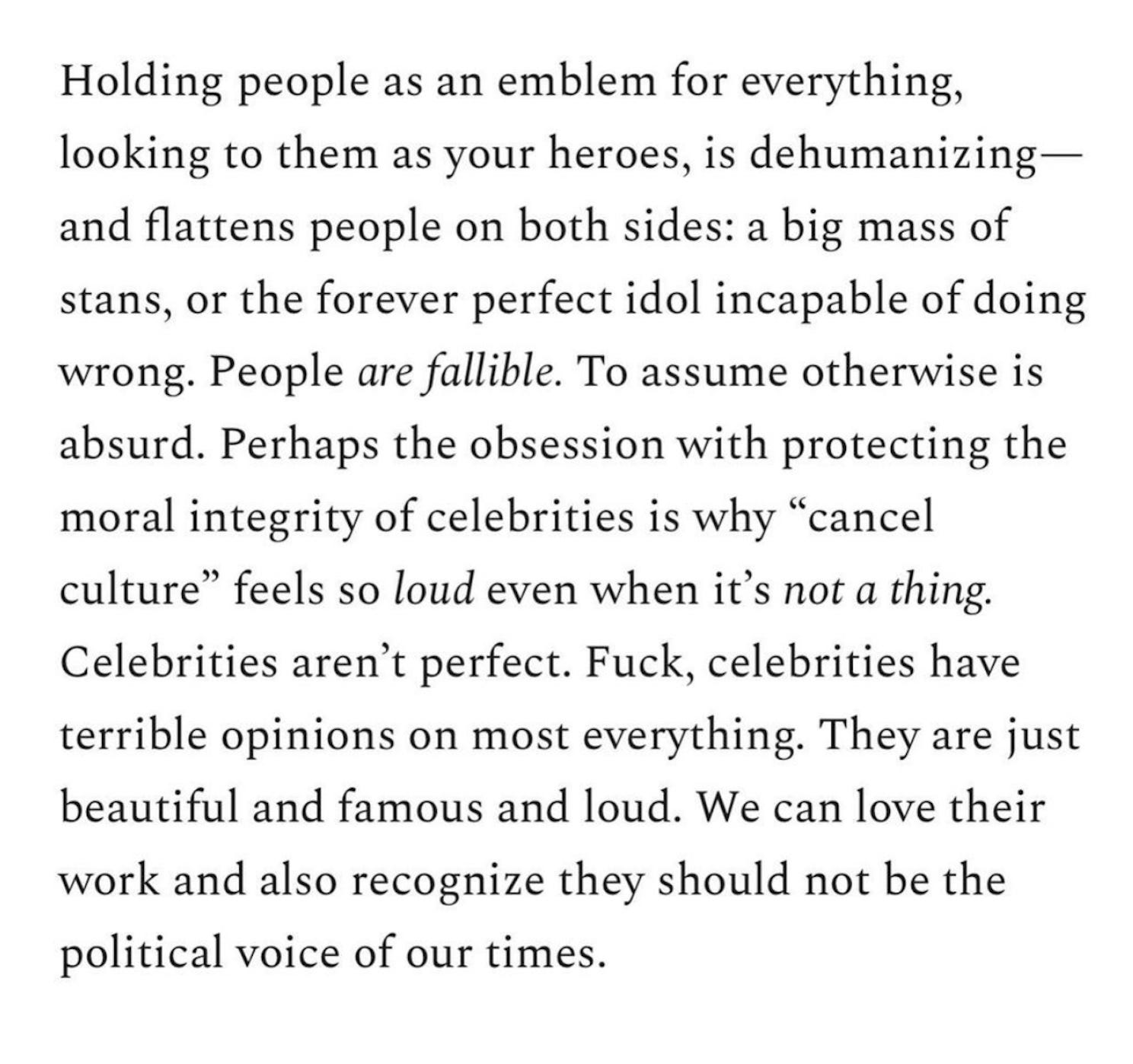
I have written and illustrated for a long while on the concept of pedestals and platforms, and how holding people to an unmeetable standard is a misdirection, a grasp for control in a world where everything feels less and less possible. It is at the root, I suspect, of so much unhinged “stan” behavior, the desperation to hold someone accountable, even if it’s a popstar, because certainly our government leaders aren’t responding. The intense fandom and overidentification serves as a tether to which we can hitch our own morals, but the internet mediated distance reminds us we can slough off our faves should they tweet wrong. If we can’t have elected officials looking out for us, then maybe we should just shit in the mosh pit, or throw a water bottle at a star, just to feel something, just to effect change. After so much yelling into the void, I wonder how much disruptive and anti-social behavior recently comes from the very basic human instinct to be seen.
The anti-cancel culture content I’ve recently seen states “cancel culture is destroying the left,” and then proceeds to list behaviors that constitute cancel culture and what someone can do to resist it. While I agree with the broad strokes here, the emphasis is unclear, and the thrust of the argument frames “cancel culture” as the biggest threat to the left which is patently wrong, embarrassingly so. Much of what these slides discuss is not, seemingly, cancel culture, but a niche set of behaviors endemic to certain parts of the internet, as discussed, which is then attributed to the entirety of “the left.” While I very much understand that sometimes you have to simplify to get your thoughts seen, that nuance does not do numbers, etc., I wonder what it does to confuse so greatly the distinctions that matter here, namely “the left” and “cancel culture.” Who are we talking about? And why? Seeing someone name the toxic behavior that we’ve seen on the internet and disavowing it is important, given that much of what this is referring to is indeed anti-social, anti-productive, cruel, and misplaced. Whether on the internet or IRL such a precedent makes it harder to get shit done. What it gestures to, perhaps, is an atrophied ability to resolve conflict, and how such failures can hinder efforts to gain power. Perhaps it points to how such “dramas” are often manufactured, they generate attention to keep us on platforms we are not users on, but the product of, part of a larger culture war done to distract people from building material power. Right?
When we discuss the failures of “leftists” and use that as a monolith, what do we mean? Is it the behavior of someone you know at a local meeting or a stranger in a tweet? Such questions are always worth asking, because they narrow down the scope of a question that is too broadly posed, and thus blames “the left” for behavior that drives away potential allies. Perhaps it is worth again asking earnestly what, exactly, would drive someone away from the left: someone’s behavior, or a dogged commitment to capitalism?
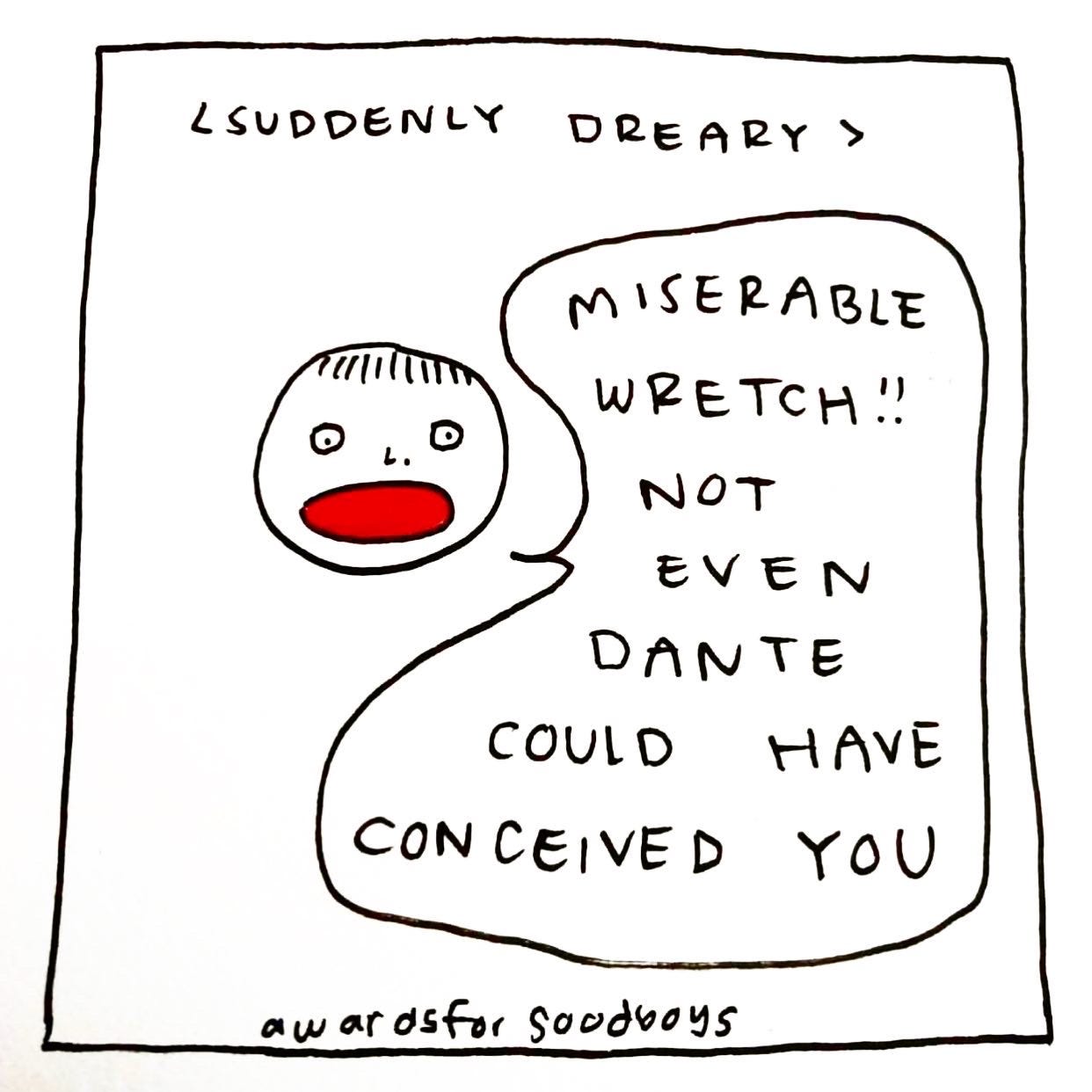
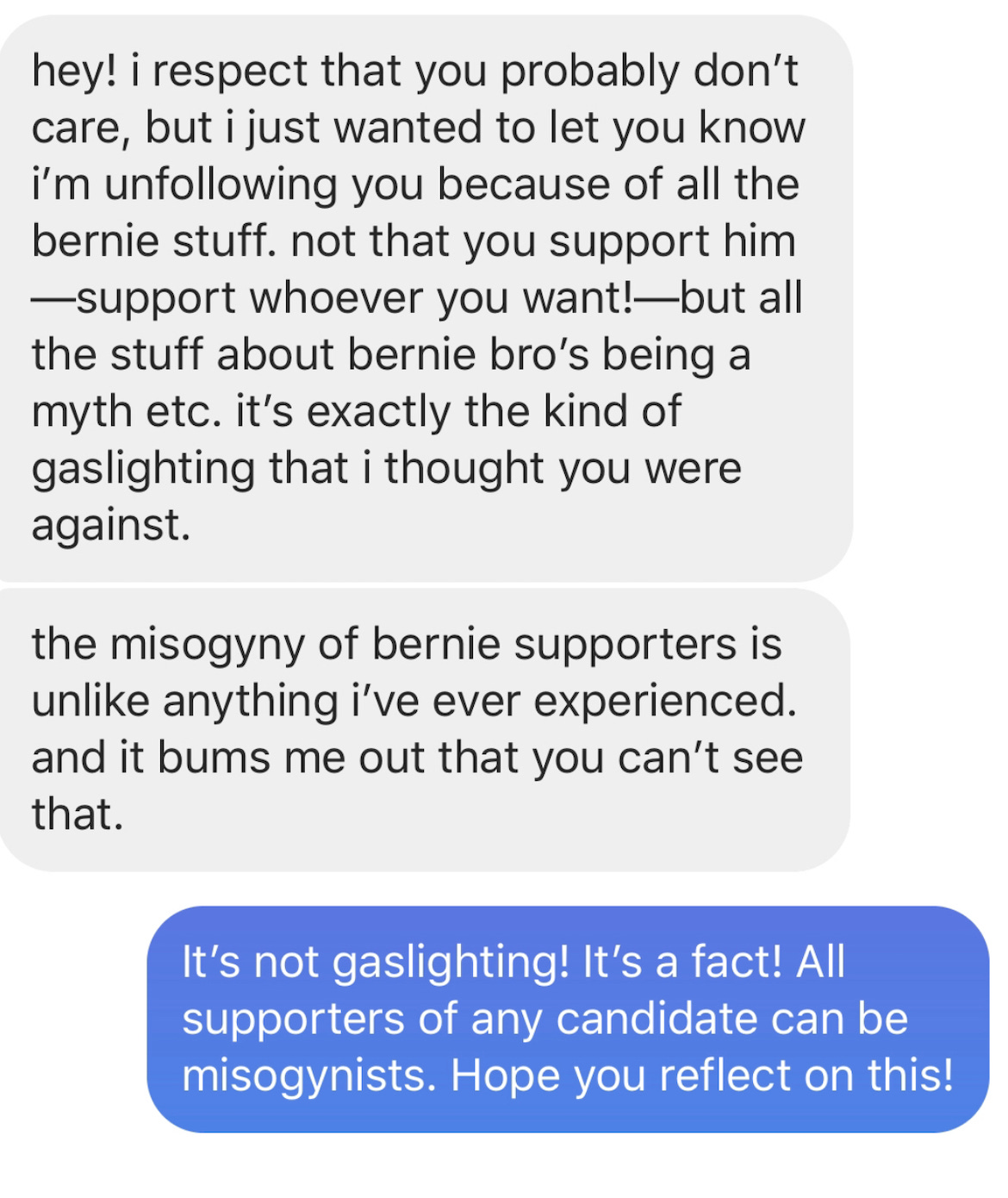
It reminds me, a bit, of fights I used to get in with Warrenistas who were indignant I would support Bernie because of the existence of Bernie Bros. They used the behavior of a few too-public figures as a metric by which to read everything else, including the actual policies being advanced, which were perhaps radical for the U.S. but not really all that radical at all. While someone being a dick to you is not great, if it dislodges your entire political beliefs then you didn’t believe those things in the first place. Otherwise you’d be able to move forward and either ignore the aggressor, or find remediation efforts in a shared community. This is not to say that there won’t be annoying, dickish people in whatever space you find yourself in. It does not matter how Good someone’s politics are, everyone–everyone–is capable of harm. (If only someone had written a book about how we all try to delude ourselves of our goodness in order to avoid looking deeply at the flaws we all have. I did. I wrote the book.) If we take that as a given, where do we go next? (I quite liked the book After Accountability, which I wrote about more extensively here, and also recommend the quoted text here The Politics of Everybody).
It is incumbent upon us too to zoom out; to chew gum and walk at the same time, and all that. If we accept that something is happening, a didactic and moralistic way of being that has haunted “leftist” spaces, then we must measure this against what is happening more broadly: that we live in a redux-McCarthyist era wherein handing out zines can get you a prison sentence; the right openly discusses “the left” as a terrorist organization; and major publications cannot stop obsessing over what the DSA is and why it is, in fact, going to destroy America. People are being doxxed, fired, disappeared for their support of Palestine, for handing out medical supplies at protests, for being an immigrant. We are living through a repressive time wherein government officials will give names of people who made Substack posts they didn’t like to border agents, which may go to Canary Mission or to add them to a list of terrorists. Try to do op-sec and get jailed. Protestors are killed or jailed, called “leaders of Antifa” and sentenced to hundreds of years in prison. Humanitarian work is called “selfie activism.” Access to healthcare is being stripped away even further and a mid-tier WNBA player is suddenly an authority on trans kids in sports. Have a little side of culture war with your climate collapse! Everything is on fire and the response is to keep bombing schools around the world. You wanted reasonable rent? You get another data center! And you, a data center for you too! Here in the U.S. we are too busy sending money to the military to drone civilians to staff federal regulators who would keep us from getting measles and pooping our pants. The country is run by a senile pack of addict gamblers, and each day we wait for His tweets to influence the stock market. It is hell. It is a fucking nightmare, is what I’m saying.
And yet, there are considerable wins. Socialists are being elected in remarkable numbers, there is an overwhelming tide-change of public opinion about Israel and their continued genocide we help fund, a seemingly more robust discussion about how billionaires should not exist, increased unionizing efforts and notable wins, anti-data center activism, as just a few examples.
These are the conditions, which perhaps makes the discussion about “leftist cancel culture” feel so misplaced, even if it refers to a real phenomenon. I yearn for this content to have been popular when it was most needed: 2020, 2021. (It did exist, but it wasn’t trendy yet.) The curdling of our brains during Covid and what Liz from TrueAnon often refers to as the “mass onboarding” of internet users during that time period gave rise to some of the strangest behavior I have ever seen, from myself included. Unspooling from that time has taken with it lingering traumas, themselves perhaps pulled from the long pre-history of internet activism of Tumblr, etc. Take that with the rapid dissolution of already flimsy social structures, it makes sense people would be desperate to seek answers of who to blame. Offering them leftists as a potential fill-in-the-blank here is not doing what anti-cancel culture influencers who consider themselves “leftists” might intend.
The anti-cancel culture slideshow tells us next actions, which include not supporting cancel culture, not sharing things you’ve heard through the grapevine, not being intimidated into not supporting someone who is actively being cancelled. Again, I agree with the broad strokes here, though I wonder at the efficacy of a post that decries prescriptive behaviors and proceeds to do the same. Sharing unverified information is certainly a problem, and should be taken alongside a larger conversation about media literacy at a time when it’s worse than ever, especially with AI-information now inextricably in the mix. But what do such rules hope to accomplish if their initial purpose was to dislodge the stringent purity culture that has been so prevalent in these very spaces? Why be dogmatic in the face of such unknowns?
When I posted about my reaction to these slides on Instagram, I got responses from people who led “cancellation efforts” against people who were actively causing harm, from people who did not believe cancel culture was real at all, from people who also agreed with the overall message of the anti-cancellation content but wondered at the impact. Just those varied responses from a very small pool of people confirms what has been discussed here, that cancel culture does not have a fixed meaning, that assuming it does discredits people who seek justice and limits the potential to have a conversation about if there are better ways, and also obscures actively unproductive behavior by lumping it under the same umbrella term that Fox News sprinkles into their fear-mongering narratives nightly. Semantics, sure, but an important distinction nonetheless.
C wrote to me: “Super shallow angle on it, but I think the cultural reaction to Love Island is a great referendum on the politics of personal responsibility. It’s seeped into our relationships and turned them into a litmus test for moral purity…we’ve got this whole thing going on where we treat the people in our phone like they’re our little Sims to be pampered or subjected to our wrath on a whim. Real taking-the-ladder-out-of-the-pool type shit.” Exactly! This is what I mean when I say I think fandom has become a primary receptacle for feelings of powerlessness. Reality stars and niche celebrities are our Sims. And now that everyone is a celebrity, the original mechanisms of fame collapsed with the internet, the direction of our ire in which to showcase the politics of personal responsibility can disperse in limitless directions.
That it is the self-defined Good Ones who take it upon themselves to delve through a starlet’s internet history and wage war on a micro-influencer and call this Politics is not the fault of the left, nor is it cancel culture, but an unfortunately Puritan grasp for change that reflects a lack of IRL options for solidarity building and an addiction to social media. “Communities” on the internet become overly imbued with political potential, likened to the only place where movement can happen. With the Sim-like experience of all being consumers/creators, every follower is not simply eyeballs but a voyeur with the power to enact change. A fan may hope their fave posts about this thing (thank GOD they did, everything is fine!) or feel disappointed if they don’t (woof unfollowing now). They may feel that if they can just get this one person to post about this one Cause, or unfollow this Problematic Person, or make everyone they know share this one infographic, everything will be OK. Dislodging oneself from this type of thinking must start at the very root, which acknowledges that while social media can be an important tool in sharing information and reaching people, it is not a miniature model of the world. It is entwined with it, yes, but the things people post or do not post almost entirely have no material consequence on the structures we are bound within.
Which brings us back to “cancel culture.” If it’s not real in the way right wing media figures think it is, and it doesn’t discuss what “leftists” often do on the internet in reference to strict policies of behavior, then why is it used so frequently as a catchall, and what does following in that trend do? I try to ask myself of things that go viral: why? Besides the black box of the algorithm. Did this get seen because it is effective communication? Is this legible by some who is not in your same niche internet community, or is it gobbledegook if you’re not addicted to Instagram? Why this, why now?
That the messaging of recent anti-cancel culture content is the same as it was during Covid, six years later during Trump 2.0 when masked bandits are disappearing and murdering our neighbors, and not “careful what you post because what you post will be literally used against you in a court of law,” seems distracting and unproductive. It is worth asking of any content that collapses an entire group into a monolith: Who is this talking to and who is this actually about? Are we using the same definitions? Words, as the saying goes, do mean things. And while words cannot change the world, how are we to build a better future if we can’t be precise about the terms we use to describe our reality, especially if such muddled usage ultimately serves the dominant narrative about “leftists” peddled by the absolute worst people on Earth?